 I asked ChatGPT’s image generator, “What sort of image would you create to illustrate the concept of a dead nation?” and this is what it produced.
Nations die. Just like people. The reasons nations die are as varied and numerous as the reasons people die. Some nations die because they just get too unwieldy to survive, like the Roman Empire. It simply became too large to manage, which led to a fatal weakening of its political structure and military capability, and ultimately to its collapse. Some die because of internal rot. The German Weimar Republic, for example, died when its president appointed a madman named Adolf Hitler to be its chancellor, and he in turn dismantled its democratic institutions. The Weimar Republic died, replaced by the Third Reich, which was supposed to last a thousand years, but it died in the most common way nations die – because they are conquered.
 There is an aphorism about preaching that says the preacher “must hold the Bible in one hand and the newspaper in the other.” This is often attributed to the influential Swiss theologian Karl Barth, whom Time Magazine in the 1960s called “the greatest living Protestant theologian.” Truth is, however, that he never really said it. What he actually said, in an interview with Time in 1963, was, “Take your Bible and take your newspaper, and read both. But interpret newspapers from your Bible.”
 I’m sure you’re all familiar with Howard Thurman’s meditation entitled The Work of Christmas:
 In any event, I know that Mother Lisa has been over all of that with them, so this sermon is not for them. It’s for you, their family and friends; it’s about their marriage, but it’s for you.
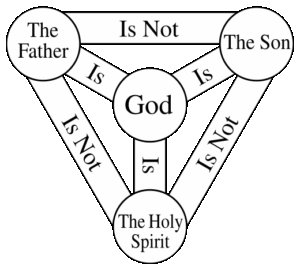 A few weeks ago, as I was looking forward to my annual cover-Rachel’s-vacation gig here at Harcourt Parish, my plan was to preach a sort of two-part sermon on play and playfulness. Seemed like a good summer-time thing to do. Last week, on Pentecost Sunday, I suggested to you that playfulness is a gift of the Holy Spirit, that play is why we were made. Today being Trinity Sunday, I planned to follow-up with a few words about how a metaphor of play and playfulness can help us understand and participate in the relational community which the triune God is.
  Y’all know who John Wesley is, or was, I’m sure. The Anglican priest who founded Methodism? My paternal grandparents were Methodists and they really tried to make me into one but, for some reason, it didn’t stick. To this day when Evelyn and I visit a Methodist church, I will often turn to her as we are leaving and say, “There’s a reason I’m not a Methodist.”
 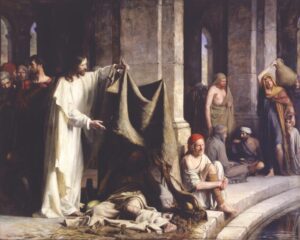 “Do you want to be made well? … Stand up, take your mat and walk.”
 Let’s have a show of hands: everyone who believes that there is a Constitution of the United States raise your hand. OK, good. Now everyone who believes in the Constitution of the United States raise your hand. Some of you might be thinking, “Wait. Didn’t he just ask us to do that?” Well, no. There’s a difference between “belief that” and “belief in.”
  One of the things I try to do when I read the stories of Jesus in the Gospels, when he uses an odd or striking metaphor like “I will make you fishers of people”
 I understand that St. Andrew’s Parish is, today, beginning its annual stewardship campaign, so I suppose it’s appropriate that we heard the story of Jesus being confronted by the wealthy man who wants to inherit eternal life in today’s Gospel reading from Mark. This tale must have been an important one to the earliest Christians, because we find it in all three of the Synoptic Gospels. Mark tells us only that the man is wealthy; Matthew adds that he is young; and Luke informs us that he is a ruler of some sort. But none of those details really changes the basic nature of the encounter: a potential disciple comes to Jesus seeking guidance and Jesus tells him that he must give up everything he possesses – “You lack one thing; go, sell what you own, and give the money to the poor….”

